
Finding Arlington Resident Records
Arlington has no single public roll of everyone who lives here. Tarrant County keeps the strongest address and ownership records, while Texas and city systems handle registration, courts, vital records, and municipal matters. Begin with a name plus an address, middle initial, former city, or date range. That extra fact helps separate people with similar names. For a past household, use a directory year or a parcel identifier before moving to an index. The result can establish a record relationship, but it may not establish current residence.
Use a source that matches the question. The Tarrant Appraisal District card links a parcel to an owner field and legal description. The County Clerk index follows property instruments. A voter result provides limited registration and polling context. Library and archive collections help reconstruct older households. Current vital records, protected voter information, and sealed court material have rules that can limit both search and access.
- Validate the street address, then look for its parcel identifiers in the Tarrant Appraisal District property search.
- Keep the situs address, owner mailing address, legal description, and georeference as separate facts.
- Search the Tarrant Official Records Search by party, subdivision, document type, or number.
- Use the Texas My Voter Portal only for permitted registration and polling context.
- For an older household, compare a directory, newspaper, or archive item with a second independent record.
Arlington Parcel Facts Need Four Labels
A Tarrant Appraisal District parcel card can show a property address, current owner, primary owner mailing address, legal description, state code, georeference, subdivision, neighborhood code, map links, and instruments. Those fields answer different questions. The situs address identifies the property location. The mailing address is where the owner receives correspondence. A legal description identifies land through a subdivision, lot, block, or related land reference. A georeference is a county mapping identifier.
That distinction matters in Arlington, where an owner can have a mailing city outside Arlington and still appear on a parcel card. It also makes a better handoff to the deed index. Record the account, site number, legal description, and georeference before assuming two similar street names describe the same parcel.
- Parcel
- A defined piece of property tracked by the appraisal district.
- Situs address
- The street address used to identify the property itself.
- Georeference
- A mapping and property-reference code used in Tarrant appraisal records.
- Index
- A searchable record list that points to an instrument or collection, not necessarily the full item.
Arlington Deed Index Search Paths
The County Clerk’s Official Records Search is the property-transfer route for Arlington. Its Real Property search accepts a grantor or grantee name, subdivision, document type, or document number. It also supplies recorded-date fields, recent-date presets, and a choice between Index Only and Index & Full Text (OCR). Index-only searching uses the information entered into the index. OCR searches document text and can be useful when a phrase is part of the instrument.
A recorded instrument can show a transfer, lien, release, plat, or other filing. It does not show an uninterrupted history of who occupied an address. The portal displays a certified-through date, but the research did not establish a single earliest online year. Older work may require tax deed cards, Archives ledgers, or an in-person request.
| Official Records field | Use for an Arlington search |
|---|---|
| Real Property search term | Grantor/grantee, subdivision, document type, or document number |
| Recorded date | Set a From and To range or use a recent preset |
| Index Only | Search indexed information, with multiple words treated separately |
| Index & Full Text OCR | Search text recognized from the document when a phrase is needed |
Arlington Resident Records Offices
Arlington is in Tarrant County, whose county seat is Fort Worth. That geography explains why key local-record offices are county offices outside city limits. The County Clerk keeps real-estate instruments and a range of county records. TAD maintains parcel cards. Tarrant Elections and the Texas Secretary of State administer separate voter routes. Each office is the custodian for its own records. The Arlington street directory has the address-by-address chain when a property location is the starting point.
Tarrant County Clerk Real Estate
100 W Weatherford St
Fort Worth, TX 76196
817-884-1195
Official Records Search
Tarrant Appraisal District
2500 Handley-Ederville Rd
Fort Worth, TX 76118-6909
817-284-0024
TAD Property Search
Tarrant County Elections
2700 Premier St
Fort Worth, TX 76111
817-831-8683
Texas My Voter Portal
Arlington Voter Roll Boundaries
The Texas My Voter Portal takes a name, county, date of birth, and ZIP to return permitted registration, VUID, and polling information. It is not a party-membership roster, and a registration result is not a complete address history. Texas protects specified voter home-address, phone, Social Security, and driver-license information. Participants in the Texas Address Confidentiality Program use a substitute address, so their actual residence should not appear in the county voter system.
Tarrant’s registration route includes applications through its elections center, post offices, city halls, libraries, and public-assistance offices. An online application must be printed, signed, then mailed or delivered. Texas Election Code sections 18.008 through 18.010 govern voter-list copies and use restrictions. For a personal lookup, compare a permitted result with a time-appropriate record instead of treating a ZIP or VUID as proof that someone lives at an address today.
Tarrant County voter-registration guidance explains the local registration path, while the state portal supplies the lookup screen.
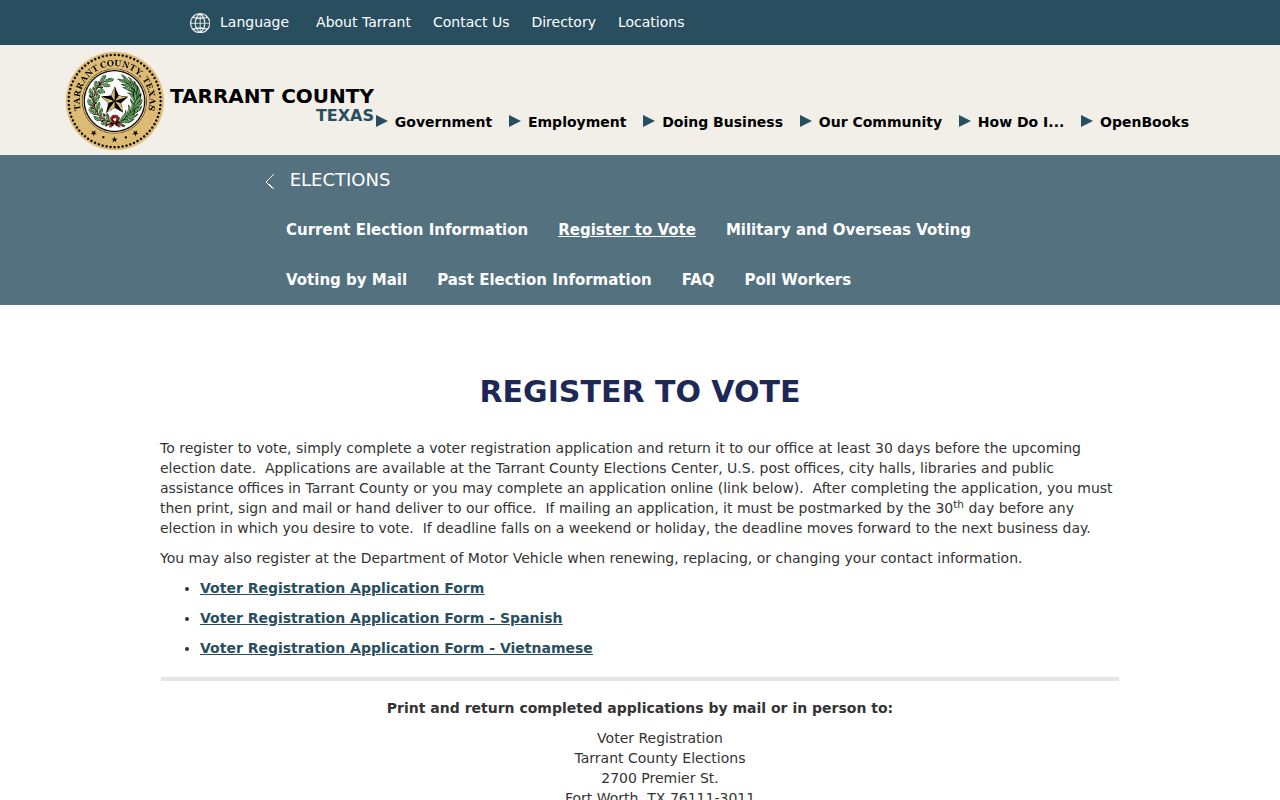
The registration guidance distinguishes the county application route from the My Voter Portal’s public lookup function.
Arlington City Records Add Context
City sources are useful when the question is narrow. The Arlington permits portal has paths to locate a business and search contractors, permits, and fire-inspection status. Its contractor results can show business name, address, contact, and registration number. The city’s permit GIS layer describes three years of permitting and has fields such as address, use, structure, declared valuation, business name, and a property GIS identifier. Those records document an addressed activity, not a private household roster.
The Arlington permit search shown below demonstrates the separate tabs used for public permit and contractor research.
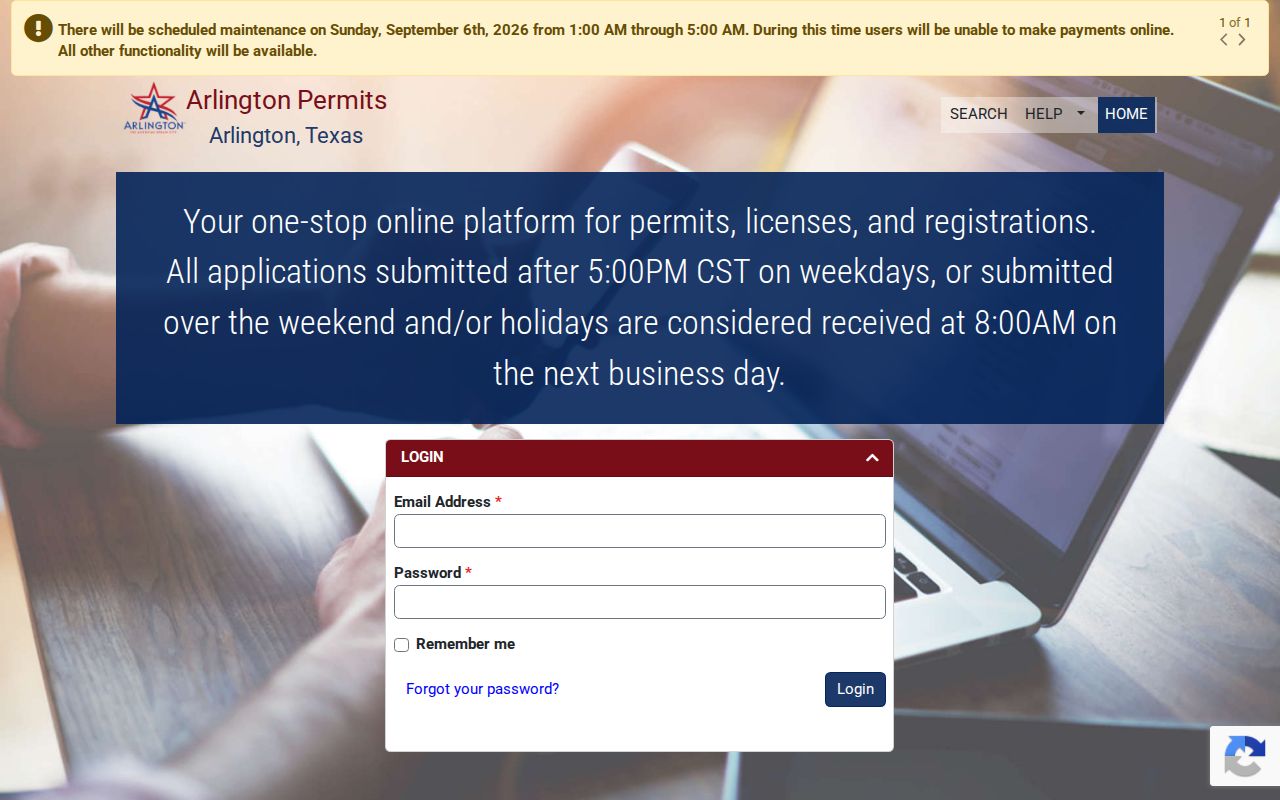
Use the address and date as context, then confirm any property relationship through the county custodian.
Current Arlington Resident Directories
Current Arlington directories are separate public systems, not one master list. A parcel card is a record of property and its owner field. A deed index records instrument parties. The voter portal supplies limited registration context under confidentiality rules. The City of Arlington’s neighborhood directory is opt-in and provides neighborhood boundaries and authorized contacts rather than every person on a block. Match the source to the relationship you need to verify.
| Source | Who It Lists | Keeper | Access |
|---|---|---|---|
| TAD Property Search | Current parcel owner fields and property identifiers | Tarrant Appraisal District | Public portal |
| My Voter Portal | Permitted registration, VUID, and polling context | Texas SOS / Tarrant Elections | Public lookup with protected fields |
| Official Records Search | Grantors, grantees, and instrument parties | Tarrant County Clerk | Public index; copies may have a fee |
| Neighborhood Directory | Opt-in neighborhood boundaries and authorized contacts | City of Arlington | Public program directory |
| Arlington permits | Business, contractor, and permit-address roles | City of Arlington | Public portal |
For a name that needs careful comparison across several official sources, the Arlington resident lookup focuses on the one-person verification sequence. Do not use a current owner, voter, or permit record alone to describe a person as a current resident.
Arlington Names in Courts and Vitals
Court systems are divided by jurisdiction. Tarrant Odyssey Public Access is the trial-court entry for district, county, and justice-court records; its visible choices include a location selector, Class C Misdemeanors Only, Case Records Search, and Court Calendar. Arlington Municipal Court handles city citations separately. Probate is a useful estate route, and federal cases use PACER rather than the county portal. A court party, filing, or docket date should never be mistaken for a current address confirmation.
For vital records, the Arlington Subcourthouse has Vital Records Suite 101 at 700 E Abram Street, while Texas DSHS manages statewide products. Texas Government Code section 552.115 makes birth records public after 75 years and death records public after 25 years. Current certificates require a qualified requester or direct tangible interest. DSHS marriage verifications begin in 1966 and divorce verifications in 1968, but a verification letter is not a certified local instrument.
Arlington Crime Search provides the municipal incident-search controls shown below.
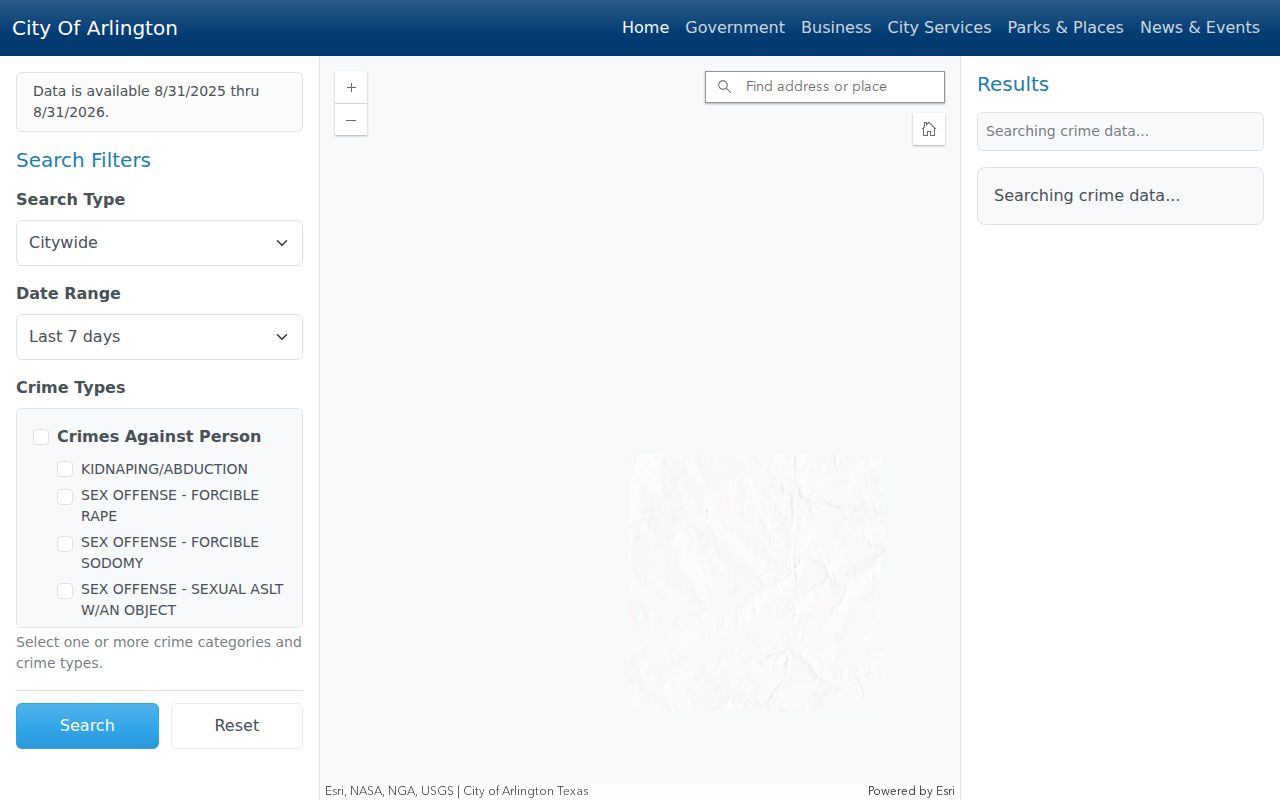
Arlington’s separate crime search has type, date-range, and crime-type controls, but it is refreshed monthly and has important exclusions. It is an incident tool, not a complete directory.
Arlington Historical Records Shelf
Historical work shifts from portals to collections. The Texas State Library lists selected Arlington city directories for 1960, 1961, 1966, 1967, 1969 through 1979, 1981, 1982, 1984, 1985–86, and 1987. Those are real gaps, not an unbroken run. Tarrant Archives has Polk Arlington volumes including Pantego for 1979, 1982, and 1984–88. The UT telephone-directory catalog spans March 1907 through April 2002 with gaps and coverage beyond Arlington.
The Arlington Public Library collections in the Portal to Texas History also include local digital material and The Arlington Journal. Search OCR for a name or street, then inspect the original scan because initials and surnames can be misread. For the full shelf, entry conventions, and year-by-year method, use the Arlington city directory.
Arlington’s 1876 Record Gap
The Tarrant County courthouse fire on March 29, 1876 destroyed most early district-court and deed material. A missing early deed can therefore be a survival problem rather than a failed search. Surveyor, sheriff, and some probate material survived. Later records may point back toward these sources, but they cannot recreate a lost original record.
Tarrant Archives gives the best fallback path. Its historic ledgers include land material for 1897–1908, property material for 1876–1917, and other court, election, marriage, school, and financial series. The County Clerk finding aid describes a 1874–2021 collection with 528 bound ledgers and notes that Archives can search detailed court and property lists on request. This local record-survival story is why a careful search notes both the source and the gap.
Historical Arlington Resident Directories
A historic directory places a name, subscriber, or household at a date. It may include an address, phone, occupation, or business connection, depending on the volume. It does not prove title and it may not prove that every person in a household lived there. Later criss-cross sections arrange listings by address, making them useful for an old block. Preserve the directory title, year, page, and the type of entry when recording a result.
For onsite research, Tarrant County Archives is at 200 Taylor Street, Suite 5200, Fort Worth, and is open Tuesday through Friday from 9 to 4:30, with Monday by appointment. The Texas State Library keeps its directories in the Austin Reading Room, where staff do not provide remote searching or transcription. Both the physical collection and a scan can be important, because OCR is not a substitute for the page image.
Arlington Official Sources Compared
Official source paths are slower when a record needs a copy request or archival visit, but they identify the custodian and record type. Commercial directory categories can combine old and current material, yet their data may be stale, incomplete, or stripped of the date and relationship that give a record meaning. For family history, reconnecting, estate work, property verification, or civic research, start with the custodian and retain the source details.
| Source path | Strength | Limit to remember |
|---|---|---|
| Official county or city record | Named custodian and stated record role | Coverage, fees, and access can vary by record |
| Library or archives collection | Dated historical context and original formats | Gaps, OCR errors, and onsite access may apply |
| Commercial directory category | May surface a possible lead | May lack date, provenance, or a reliable relationship label |
Note: A source without a date or custodian should be treated as a lead for verification, not a final finding about an Arlington person.
Arlington Record Access Limits
Texas Public Information Act access begins with the governmental body that holds the record. It does not erase other confidentiality laws. Juvenile, sealed, expunged, family, adoption, and protected mental-health court material is not a complete public-name universe. The Driver’s Privacy Protection Act limits personal information from motor-vehicle records. Current vital records have their own eligibility rules. A missing result can reflect a protected record, a coverage gap, a spelling issue, or a different custodian.
When an Arlington source is unavailable online, start with the office that created or holds it. A Texas Public Information Act request can seek public material from a governmental body, but the request does not require an office to create a new record or disclose information made confidential by another law. The Texas Attorney General says a body should promptly produce public information, or notify the requestor if it cannot do so within 10 business days. Costs follow the statutory and Attorney General framework rather than a single guaranteed fee.
Lawful personal use. Arlington records can support family history, reconnecting, estate matters, property questions, and civic research. Do not use them to stalk, harass, intimidate, or harm anyone.
Texas TDLR Verify is another official, narrow record path for a professional credential. It verifies a public credential at a point in time, not a home address or personal identity. Its search screen is shown below.
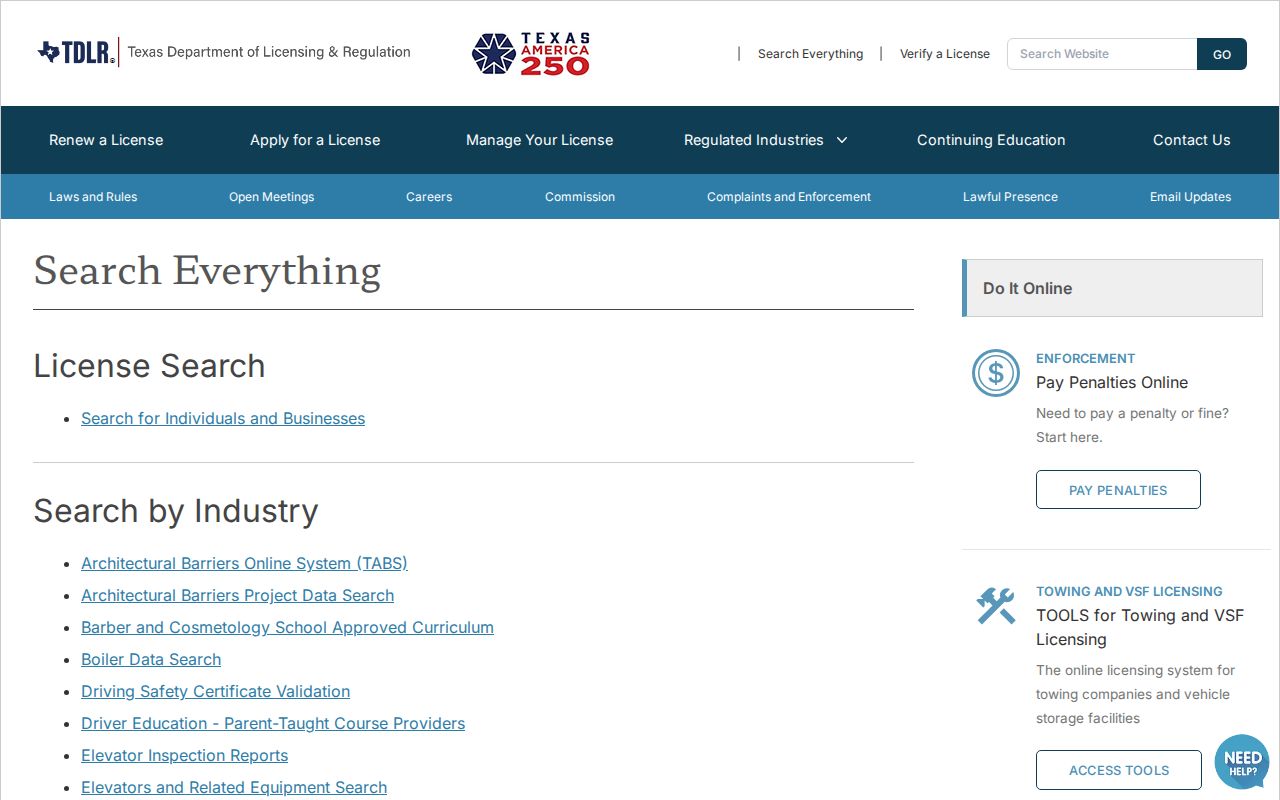
Use the responsible agency’s result with its status and date, then avoid extending a license record beyond what it actually says.