
Arlington Previous Residents by Record Era
No single Arlington system identifies all previous residents of an Arlington address. Start an Arlington history with a current parcel identifier, then choose the source that fits the date and relationship being tested. The online Official Records Search is the current grantor-grantee index, the separate tax deed-card tool reaches older Arlington property history, and archival ledgers preserve other Arlington historical series. Arlington directory entries can fill a dated human layer between transfers. Each source has different gaps, fields, and access conditions.
| Source | Years It Covers | Where Held | What It Shows |
|---|---|---|---|
| Tarrant County Official Records Search | Current index; exact earliest online year is not posted | Tarrant County Clerk online portal | Grantor, grantee, subdivision, document type or number, recorded date, and index or OCR search |
| Tarrant tax deed-history cards | 1876–1984 | Tarrant County tax deed-card search | Subdivision, block, lot group, abstract, grantee, and historical property trail |
| Tarrant County historic ledgers | Land 1897–1908; property 1876–1917 | Tarrant County Archives | Searchable scans of separate county ledger series |
| Arlington directory and telephone sources | Selected years from March 1907 through April 2002, with gaps | UT catalog, Texas State Library, and Archives collections | Dated directory or telephone listings, not title evidence |
Use the Arlington record date instead of forcing a source into a wider period than it states. The County portal, used for Arlington searches, displays a certification date of 08/28/2026, but that date is not a statement of its earliest coverage. Earlier Arlington searches may need deed cards, Archives material, or the genealogy grantor-grantee index identified for 1876–1920.
Freeze an Arlington Parcel Before Searching the Past
For Arlington previous residents, first make a four-part note from the Tarrant Appraisal District property search: TAD account or site number, legal description, subdivision and lot or abstract, and georeference. Keep the Arlington property or situs address separate from the primary-owner mailing address. A current Arlington card can also show state code, neighborhood code, and a deed-search link. These Arlington fields are keys for the next source, not interchangeable ways to say “resident.”
An Arlington address can have four useful vocabularies: postal wording, parcel identifiers, title terms, and historic words such as abstract or tax deed card. The Arlington sequence is address → account and legal description → subdivision or abstract → recorded instrument or legacy card. Capture each form before changing spelling or modernizing an Arlington street name. It makes it much easier to tell whether a historical match belongs to the same Arlington parcel.
Note: A TAD mailing address can be outside Arlington, so it should be recorded as correspondence information rather than proof of physical presence.
Arlington Previous Residents in Tax Deed Cards
The separate Tarrant tax deed-history card search is a practical bridge for Arlington property research from 1876 through 1984. It searches by subdivision name, subdivision code, block number, and lot group, or by abstract number and grantee. Begin with the legal description copied from the current Arlington parcel record. The tool is especially useful when a current Arlington account does not make an older lot name easy to find in the newer index.
Open the Tarrant tax deed-card search to compare its subdivision and abstract fields with the identifiers in hand.
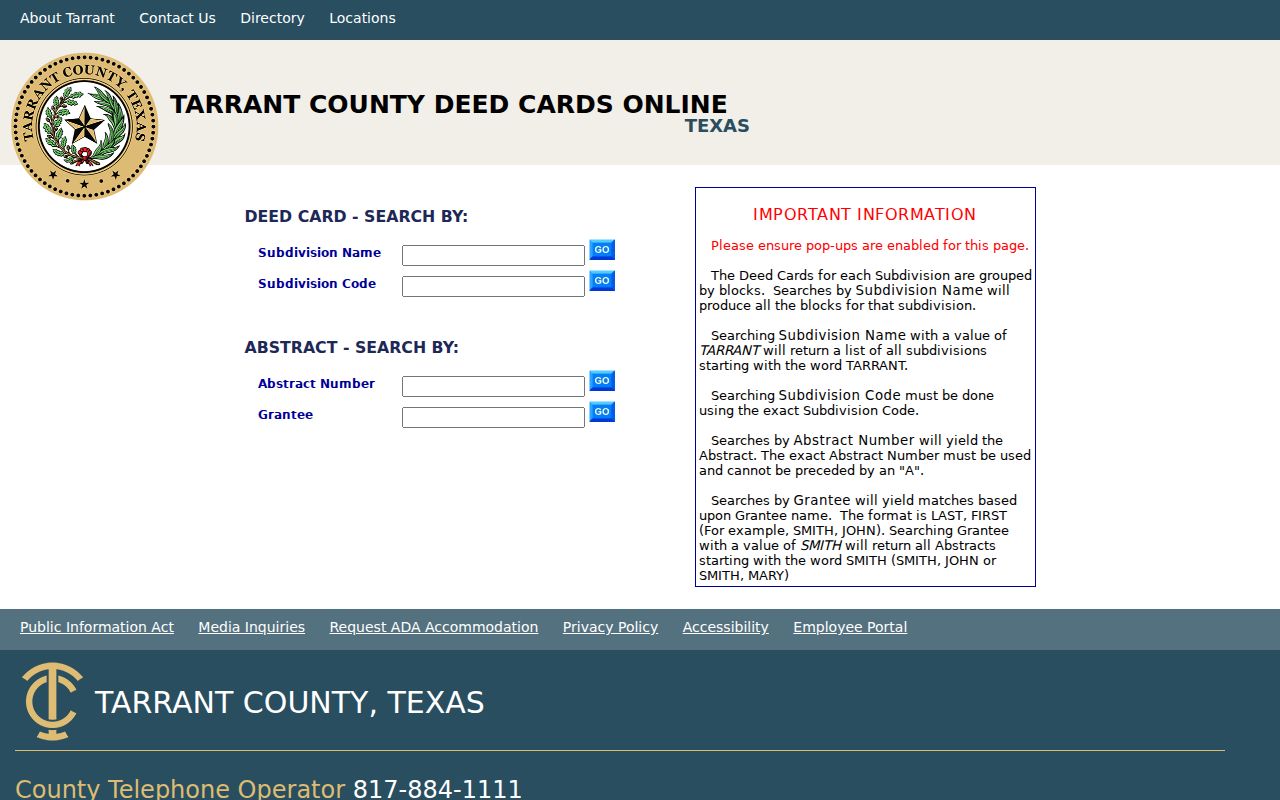
The form uses a few important Arlington conventions: a subdivision search returns all blocks, subdivision codes must match exactly, abstract numbers omit a leading A, and grantee searches use LAST, FIRST. A partial surname returns names beginning with the entered text. An Arlington card can support a property or transfer trail, but it does not establish who lived at an Arlington address between records.
Following Arlington Previous Residents Through Transfers
The Tarrant County Official Records Search has a Real Property search term for grantor or grantee, subdivision, document type, or document number. It also offers recorded-date controls and a choice between Index Only and Index & Full Text (OCR). An instrument tied to an Arlington parcel traces a recorded transaction. It is not a continuous record of who was present at an Arlington street address after or before the recording date.
- Use the current Arlington TAD card to save the account, legal description, subdivision, and current owner and mailing fields separately.
- Search the current owner or the Arlington legal description in Official Records and locate the purchase or other relevant instrument.
- Read the recorded date, document type and number, grantor, grantee, and legal-description fields before moving backward.
- Search the earlier Arlington transfer party as a grantee to locate that party's acquisition, then repeat while the identifiers continue to match.
- When the portal trail is thin, use the 1876–1984 deed cards, Archives ledgers, or the genealogy grantor-grantee material rather than assuming a missing online result ends the chain.
- Grantor
- The party transferring an interest in a recorded instrument.
- Grantee
- The party receiving an interest in that instrument.
- Chain of title
- A sequence of recorded conveyances connected by the same legal description or parcel identifiers.
- Legal description
- The subdivision, lot, block, abstract, or other formal land description used to distinguish a parcel when street wording changes.
Arlington Previous Residents Beyond the Online Index
When an Arlington transfer trail reaches a gap, the Tarrant County historic ledgers offer separately maintained county series for Arlington research. The land ledgers span 1897–1908 and the property ledgers span 1876–1917. Other scanned series include marriage licenses for 1875–1900, civil court, criminal, school, election, financial, naturalization, and official bond or oath records. Many PDFs are searchable, but handwritten fields may require careful visual review.
Review the Tarrant historic-ledgers collection before deciding which dated register could answer an early address question.
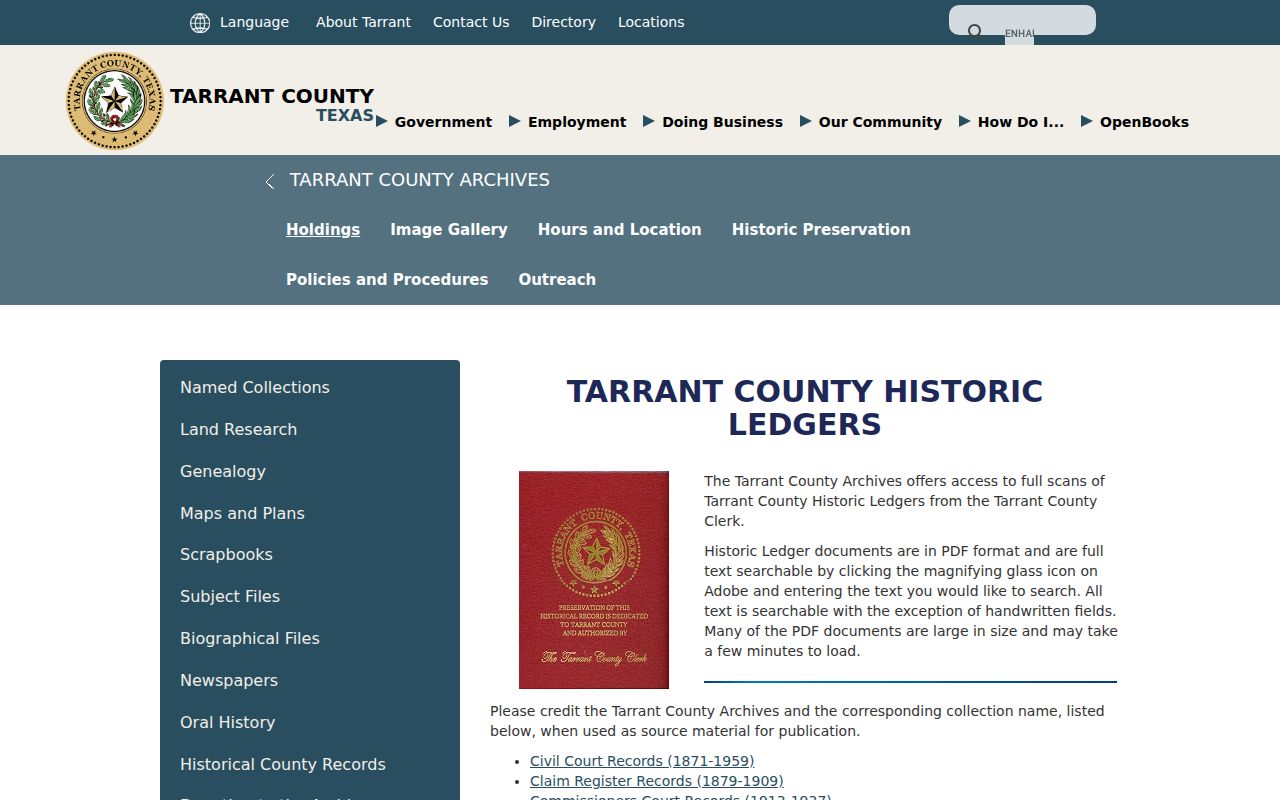
These volumes are records of distinct county functions, not a single Arlington address roster. They can supply a name, date, land reference, probate lead, or property reference that moves Arlington research to another custodian. The Archives also holds Arlington directories, maps, school census material for 1919–1970, early probate abstracts, and pre-1900 marriage resources.
Arlington Previous Residents in Directory Years
Deed parties answer a transfer question. Dated Arlington directory evidence answers a different question: who was listed at an Arlington street or telephone number when that volume was issued. The Texas State Library lists selected Arlington years with visible gaps, Tarrant Archives holds Polk directories including Pantego for 1979, 1982, and 1984–88, and the UT telephone catalog begins in March 1907 and ends in April 2002 with gaps. Use the closest documented Arlington volume, then keep its relationship label as “directory listing” or “telephone subscriber.”
The historical collection details and access limits are on the Arlington city directory page. Pair Arlington directory dates with census schedules, newspaper notices, probate abstracts, or cemetery material only after retaining the original page and year. The match is stronger when the Arlington street form, family name, and date agree, but it still does not convert a directory listing into a title record.
- Choose the directory or telephone volume closest to the date after a recorded transfer.
- Copy the name, street line, page, volume date, and the exact wording that identifies the listing.
- Compare a census schedule or newspaper item from a compatible period without merging the two source labels.
- Check the next available directory year for a move, changed spelling, or changed street form.
- Return to the parcel and deed trail when a directory entry needs a property connection.
Arlington Previous Residents and Legacy Street Names
Old Arlington address research can fail when an Arlington street name changed between record eras. Arlington's 2021 Council action changed South Center Street between Arbrook Boulevard and Southeast Green Oaks Boulevard to Dr. Martin Luther King Jr. Drive, effective September 1, 2021. In the Arlington UTA area, 1991 Board material records Campus Drive and part of Monroe Street becoming S.W. and S. Nedderman Drive, effective November 1, 1991. Search both historical and current Arlington forms before rejecting a potential match.
The Arlington city street code ties official street names and map references to the 1955 Freese/Nichols map, but it does not promise that every older Arlington number remained unchanged. The original Arlington town plat was copied in 1913. Compare an Arlington plat, legal description, map, and directory wording when the street line is older than the current address system.
Arlington Previous Residents After the 1876 Fire
The courthouse fire on March 29, 1876 explains a real break in the Tarrant County trail for Arlington research. Most early district-court and deed material was lost. Surveyor and sheriff records, part of the chief-justice records, and probate estate material survived. A missing early Arlington deed is therefore a survival issue as well as a search issue. Start with surviving probate, surveyor, sheriff, and Archives descriptions before treating an empty result as proof that no record existed.
The Tarrant County Clerk finding aid describes a 1874–2021 collection with 528 bound ledgers, and the Archives can search a more detailed court and property list on request. Later tax deed cards and historic-ledger scans may provide a bridge after the fire. The 1913 copied town plat is another point of comparison between early lot references and later Arlington street addresses.
Note: A record gap should remain visible in a house history instead of being filled with an unsupported owner or household claim.
Labeling Arlington Previous Residents Carefully
Use a precise label for each Arlington result. “Owner of record” belongs to a current parcel field. “Transfer party” belongs to a grantor or grantee in an instrument. “Directory listing” belongs to a dated city or telephone directory. A probate, cemetery, newspaper, or permit record has its own relationship. This protects the distinction between a property trail and a household trail, especially where a record has no continuous account of who lived at an address.
| Owner of record | A name on a TAD parcel card or property record, with its displayed date and field context. |
|---|---|
| Transfer party | A grantor or grantee on a recorded instrument, tied to that instrument's date and legal description. |
| Directory listing | A person or subscriber printed at an address in a specific directory or telephone volume. |
| Historical reference | A name in an Archives ledger, newspaper, cemetery, or probate source, described by that source's own role. |
Lawful use. Use Arlington house and family-history records for personal, lawful research. Do not use public records to locate, monitor, intimidate, threaten, or repeatedly contact someone, and do not use findings to harass anyone.